
9 November 2026
Hay Fever or a Cold? Making Sense of Johannesburg’s Seasonal Sniffles
Hot sunshine one day, heavy rain the next, and now you’re reaching for the tissues. With Johannesburg’s changing weather, it’s tempting to blame the temperature for a runny nose.
But sneezing, congestion and watery eyes can have different causes. Understanding what might be behind your symptoms can help you choose appropriate relief.
So, is it hay fever, a cold, or something that needs a closer look?
Can changing weather cause the sniffles?
Weather can influence how much pollen is released and how it moves through the air. Rain often washes pollen away, while warm, dry and windy conditions can encourage its release and spread. Thunderstorms can sometimes worsen symptoms in people with pollen allergies or asthma. That does not mean every rainy or hot day will trigger allergies. [1]
A cold, however, is caused by a virus, not simply by moving between hot and cool temperatures. [2]
Hay fever or a cold: clues to look for
Hay fever, also called allergic rhinitis, happens when your immune system reacts to allergens such as pollen. Common clues include repeated sneezing, an itchy nose and itchy, watery eyes. Symptoms may recur around particular triggers. [3]
| What you notice | More suggestive of hay fever | More suggestive of a cold |
|---|---|---|
| Itchy nose or itchy, watery eyes | Common | Less typical |
| Sneezing and a runny or blocked nose | Common | Common |
| Sore throat and feeling generally unwell | Can occur, but less characteristic | Common |
| Fever or body aches | Not typical of hay fever | Can occur with a viral infection |
| How long symptoms last | May continue or recur with allergen exposure | Usually starts improving within one to two weeks |
These are clues, not a diagnosis. Symptoms overlap, and other respiratory infections can also cause similar symptoms. [2, 4, 5]
Simple steps that may help
If pollen seems to trigger your symptoms, try:
- Wearing wraparound sunglasses outdoors.
- Showering and changing clothes after spending time outside.
- Keeping windows closed when pollen levels are high.
- Avoiding drying bedding and clothing outdoors on high-pollen days. [4]
Check local pollen information instead of assuming the weather tells the whole story. The South African Pollen Monitoring Network provides city-specific information that can help you understand what is being measured in your area. [6]
If you have a cold, rest, drink enough fluids and wash your hands regularly to reduce spread. Antibiotics do not treat the viruses that cause colds. [5]
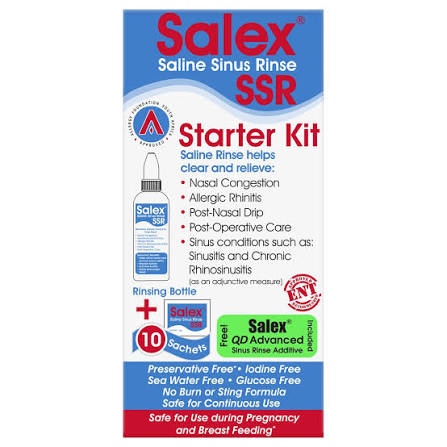
Our product recommendation: Salex SSR Starter Kit
For someone who would benefit from a nasal rinse, the Salex SSR Starter Kit is an option worth discussing with our pharmacist.
It uses a rinse bottle and saline sachets to prepare a solution that helps flush excess mucus from the nasal passages. Nasal rinsing can also help remove pollen, dust and other debris. [7, 8]
Why consider a rinse? It provides a larger-volume wash than a fine nasal mist. It may suit someone troubled by mucus build-up who is comfortable preparing the solution and using the bottle correctly. It requires preparation and cleaning, so ask our pharmacist to explain the technique before you start.
A saline rinse can support symptom relief, but it does not cure a cold or replace treatment needed for persistent allergies.
Use it safely:
- Prepare the solution exactly as directed on the pack.
- Use distilled, sterile, or previously boiled and cooled water. Never use water straight from the tap or boiling-hot water.
- Follow the instructions for cleaning the bottle and discard unused prepared solution.
- The manufacturer states that the product is non-sterile and not suitable for immunocompromised patients.
- Ask about the appropriate kit for a child. Children should use nasal rinses only under a doctor’s direction. [7, 9]
Ask our pharmacist about the Salex SSR Starter Kit
Order on WhatsAppWhat if rinsing is not enough?
Persistent allergic symptoms may need treatment that addresses the underlying inflammation. Our pharmacist can help assess your symptoms and explain appropriate next steps. [10]
Tell us if you are pregnant or breastfeeding, take other medicines, have a long-term condition, or are choosing treatment for a child.
When should you seek medical help?
Seek urgent medical attention for breathing difficulty, chest pain or significant wheezing. Severe breathing difficulty is an emergency.
Arrange medical advice if symptoms worsen, a fever lasts more than three days, or cold symptoms are not improving after ten days. Get advice earlier if you have a weakened immune system, a significant long-term condition, or concerns about a child. [5]
Allergy symptoms that regularly disrupt sleep or daily life also deserve assessment. [3]
Let’s help you choose appropriately
Unsure whether a nasal rinse is right for you? Contact Houghton Pharmacy on WhatsApp or speak to our pharmacist about the Salex SSR Starter Kit.
Tell us your symptoms, how long you’ve had them and who the product is for. We can help check suitability, explain correct use and advise when medical attention is the better next step.
This article provides general health information and does not replace an individual assessment. Always read the product label and use products as directed.
References
-
Met Office, Pollen allergies; Australasian Society of Clinical Immunology and Allergy, Thunderstorm asthma.
-
Centers for Disease Control and Prevention, About the common cold.
-
Allergy Foundation South Africa, Allergic rhinitis.
-
NHS, Hay fever.
-
NHS, Common cold.
-
South African Pollen Monitoring Network, Local pollen reports and information.
-
Salex, Salex SSR Starter Kit: manufacturer’s product information and instructions.
-
US Food and Drug Administration, Is rinsing your sinuses with neti pots safe?.
-
Centers for Disease Control and Prevention, How to safely rinse sinuses.
-
Allergy Foundation South Africa, Nasal sprays and washouts.
Questions about your symptoms or a product?
Call us on 010 753 0341